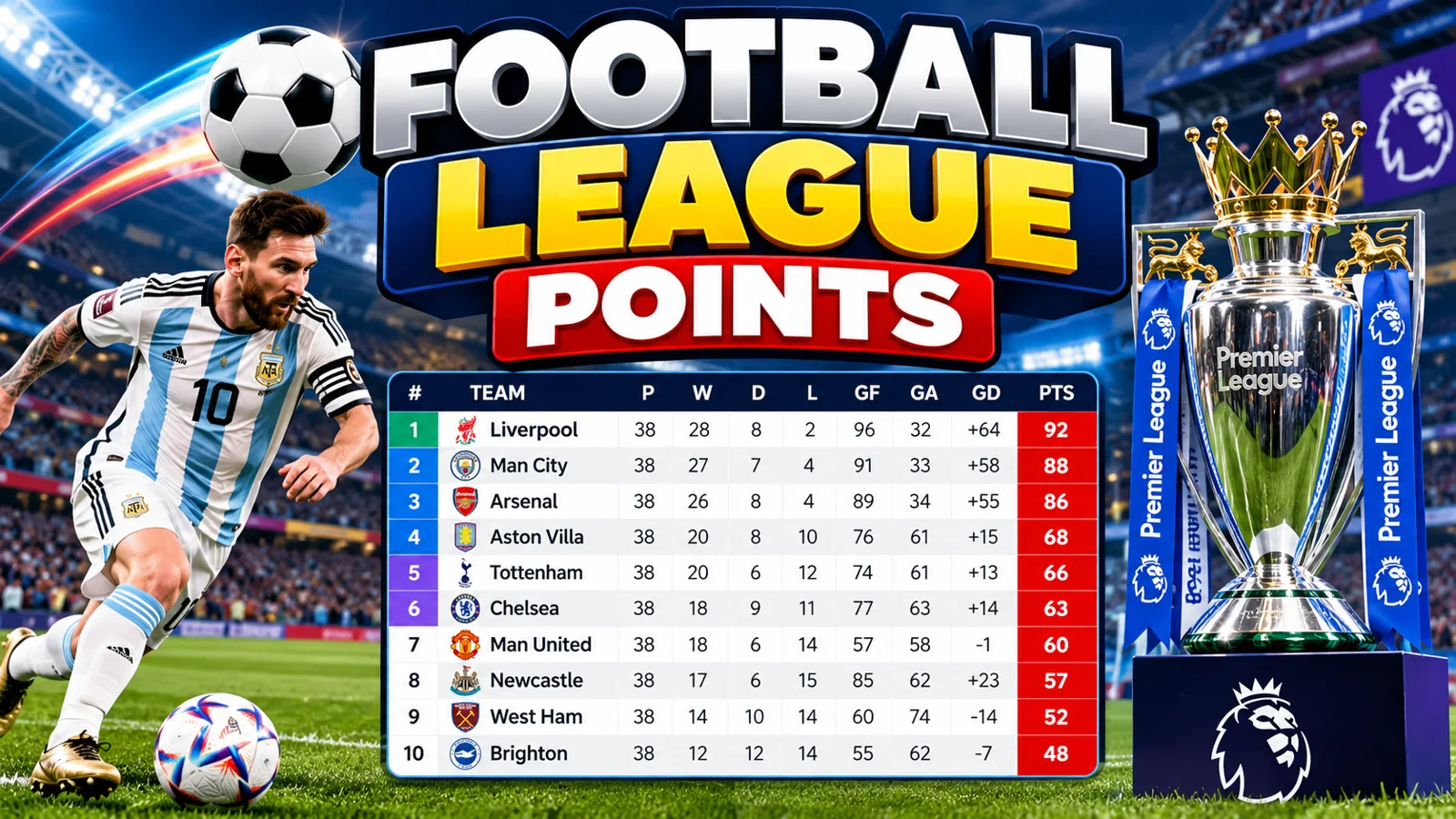
Football league tables summarize results, goals and competition rules. Learn how standings are assembled and why the points total is only the start of ranking teams.
Common league points = 3 × wins + 1 × draws + 0 × losses; goal difference = goals for − goals against.
Use the matching Sports4u calculator to check the arithmetic; verify competition-specific rules with the organizer.
Why tables have more than one column
A league table typically displays matches played, wins, draws, losses, goals scored, goals conceded, goal difference and points. Each column answers a different question. Points capture results under the league’s scoring system. Goal difference captures the cumulative net margin of goals. Games played helps readers identify uneven schedules. A well-designed table makes all these fields available rather than showing points without context.
Practical check: write down the input values and units first, then verify the operation independently. Interpret the result against the relevant match, workout or competition conditions instead of using the number without context.
How a standard three-point system works
Many football leagues award three points for a win, one for a draw and none for a loss. Under this convention, a club with 12 wins, five draws and seven defeats has 41 points after 24 matches. Calculate 12 × 3 + 5 = 41. Some historical or specialized competitions use different systems, point deductions, bonuses or disciplinary adjustments. Treat the common formula as the default only after verifying the league’s regulations.
Practical check: write down the input values and units first, then verify the operation independently. Interpret the result against the relevant match, workout or competition conditions instead of using the number without context.
Check internal consistency
The number of games played should equal wins plus draws plus losses for a basic completed-results table. If a team is listed with 20 played, ten wins, eight draws and three losses, the values do not reconcile: they sum to 21. Check for abandoned or awarded matches and data-entry errors. It is good practice to validate each row automatically before presenting standings. This prevents convincing-looking but fundamentally incorrect tables from being shared.
Practical check: write down the input values and units first, then verify the operation independently. Interpret the result against the relevant match, workout or competition conditions instead of using the number without context.
Goal difference explained
Subtract goals against from goals for. A side that scores 48 and concedes 32 has a goal difference of +16. A side scoring 25 and conceding 33 has −8. It is possible for a team to have the same points as another yet a much stronger goal difference. However, not every league uses goal difference as its first tie-breaker; some prioritize head-to-head results, number of wins, goals scored or specialized playoff conditions.
Practical check: write down the input values and units first, then verify the operation independently. Interpret the result against the relevant match, workout or competition conditions instead of using the number without context.
What happens when points are tied
There is no universal ordering across all football competitions. One might rank on goal difference, then goals scored, while another starts with head-to-head points or head-to-head goal difference. Certain leagues may require playoffs. Before building an automated table, obtain the competition handbook and make the rule order explicit. A generic generator can calculate the common fields but must not silently present a league-specific tie-break as official when it is not supported.
Practical check: write down the input values and units first, then verify the operation independently. Interpret the result against the relevant match, workout or competition conditions instead of using the number without context.
Points deductions and awarded results
A club may receive a disciplinary deduction, or a match can be awarded by administrative ruling. A simple wins-and-draws calculation would then disagree with the official points total. If tracking a real league, add a clearly labeled adjustment field with the authoritative source and date. Never guess the effect of a pending appeal. Show preliminary tables as provisional until a decision is published, and update explanatory notes rather than silently editing previous figures.
Practical check: write down the input values and units first, then verify the operation independently. Interpret the result against the relevant match, workout or competition conditions instead of using the number without context.
Sorting a table responsibly
First sort by the league’s prescribed primary measure, usually points. Apply tie-breakers only to teams that remain tied. Maintain consistent handling of incomplete fixtures and postponed games. If the data is not live, display the last update date. Record the fixture result, not just the final team totals, so mistakes can be traced. For youth leagues or social tournaments, publish the tie-break rules before play begins to avoid disputes.
Practical check: write down the input values and units first, then verify the operation independently. Interpret the result against the relevant match, workout or competition conditions instead of using the number without context.
How to interpret form without overclaiming
Points per match is points divided by games played. It can help compare teams with different games completed, but it is not automatically a league tie-break. Recent five-match form, goal difference and opponent difficulty add additional context. Avoid declaring a champion solely because a team has the highest current points-per-match rate. Remaining fixtures, penalties and official competition regulations determine the final outcome.
Practical check: write down the input values and units first, then verify the operation independently. Interpret the result against the relevant match, workout or competition conditions instead of using the number without context.
Worked examples and situations to practice
These are hypothetical practice figures, not live scores or real athlete records. They are designed to make the calculations auditable and help you recognize common input errors.
Strong record
Result: 60 points from 18 wins and 6 draws.
Eighteen wins and six draws produce 60 points before counting any defeats.
Try this: Recalculate the result from the raw figures. Decide which additional context, such as competition rules, attempts, wickets or playing conditions, you would need before drawing a conclusion.
Unbeaten start
Result: 14 points from 4 wins and 2 draws.
Four wins and two draws produce 14 points.
Try this: Recalculate the result from the raw figures. Decide which additional context, such as competition rules, attempts, wickets or playing conditions, you would need before drawing a conclusion.
Draw-heavy season
Result: 34 points from 7 wins and 13 draws.
Seven wins and thirteen draws produce 34 points.
Try this: Recalculate the result from the raw figures. Decide which additional context, such as competition rules, attempts, wickets or playing conditions, you would need before drawing a conclusion.
Tough month
Result: 6 points from 1 wins and 3 draws.
One win and three draws give six points.
Try this: Recalculate the result from the raw figures. Decide which additional context, such as competition rules, attempts, wickets or playing conditions, you would need before drawing a conclusion.
Perfect five
Result: 15 points from 5 wins and 0 draws.
Five wins and no draws produce fifteen points.
Try this: Recalculate the result from the raw figures. Decide which additional context, such as competition rules, attempts, wickets or playing conditions, you would need before drawing a conclusion.
Even record
Result: 40 points from 10 wins and 10 draws.
Ten wins and ten draws yield forty points.
Try this: Recalculate the result from the raw figures. Decide which additional context, such as competition rules, attempts, wickets or playing conditions, you would need before drawing a conclusion.
Late recovery
Result: 28 points from 8 wins and 4 draws.
Eight wins and four draws produce twenty-eight points.
Try this: Recalculate the result from the raw figures. Decide which additional context, such as competition rules, attempts, wickets or playing conditions, you would need before drawing a conclusion.
Two-match swing
Result: 6 points from 2 wins and 0 draws.
Two wins earn six points, compared with two points for two draws.
Try this: Recalculate the result from the raw figures. Decide which additional context, such as competition rules, attempts, wickets or playing conditions, you would need before drawing a conclusion.
Key terms and definitions
- Played
- Matches completed by the team.
- Wins, draws, losses
- Results that sum to games played in a basic league table.
- Goal difference
- Goals scored minus goals conceded.
- Tie-break
- A competition-specific rule used when teams have equal points.
Step-by-step accuracy checklist
- Identify the exact question you need answered before selecting a statistic or calculator.
- Write down the original data and its source; do not begin with a rounded display figure.
- Check units, decimal notation, and whether an exception changes the denominator.
- Apply the published formula and retain enough precision for verification.
- Compare the result with an independently worked example or trusted official data.
- Label estimates and provisional calculations clearly; include competition context when applicable.
- Document the date and specific version of any competition rule used.
- Use the result to answer the original question rather than making broad claims the number cannot support.
Tools you can use next
For faster calculations, these browser-based tools can help you check sample numbers and experiment with your own inputs. They do not replace official match records, medical advice or an event organizer’s rulebook.
Frequently asked questions
Do all football competitions use three points for a win?
No. It is common but should always be verified for the specific competition. When comparing results, keep the original measurements available and confirm any rules or assumptions that affect the calculation.
What if two teams have identical goal difference?
The next tie-break depends on the league regulations; examples include goals scored or head-to-head. When comparing results, keep the original measurements available and confirm any rules or assumptions that affect the calculation.
Can points be negative?
Yes. A league can apply disciplinary deductions that lower the recorded total. When comparing results, keep the original measurements available and confirm any rules or assumptions that affect the calculation.
Are tables generated here official?
No. They are organizing tools; official league standings come from the organizing body. When comparing results, keep the original measurements available and confirm any rules or assumptions that affect the calculation.
Editorial note: This educational guide uses hypothetical worked examples and transparent arithmetic. Sports4u does not claim that calculations represent official competition statistics. Always check the relevant governing body or organizer for event-specific rules.