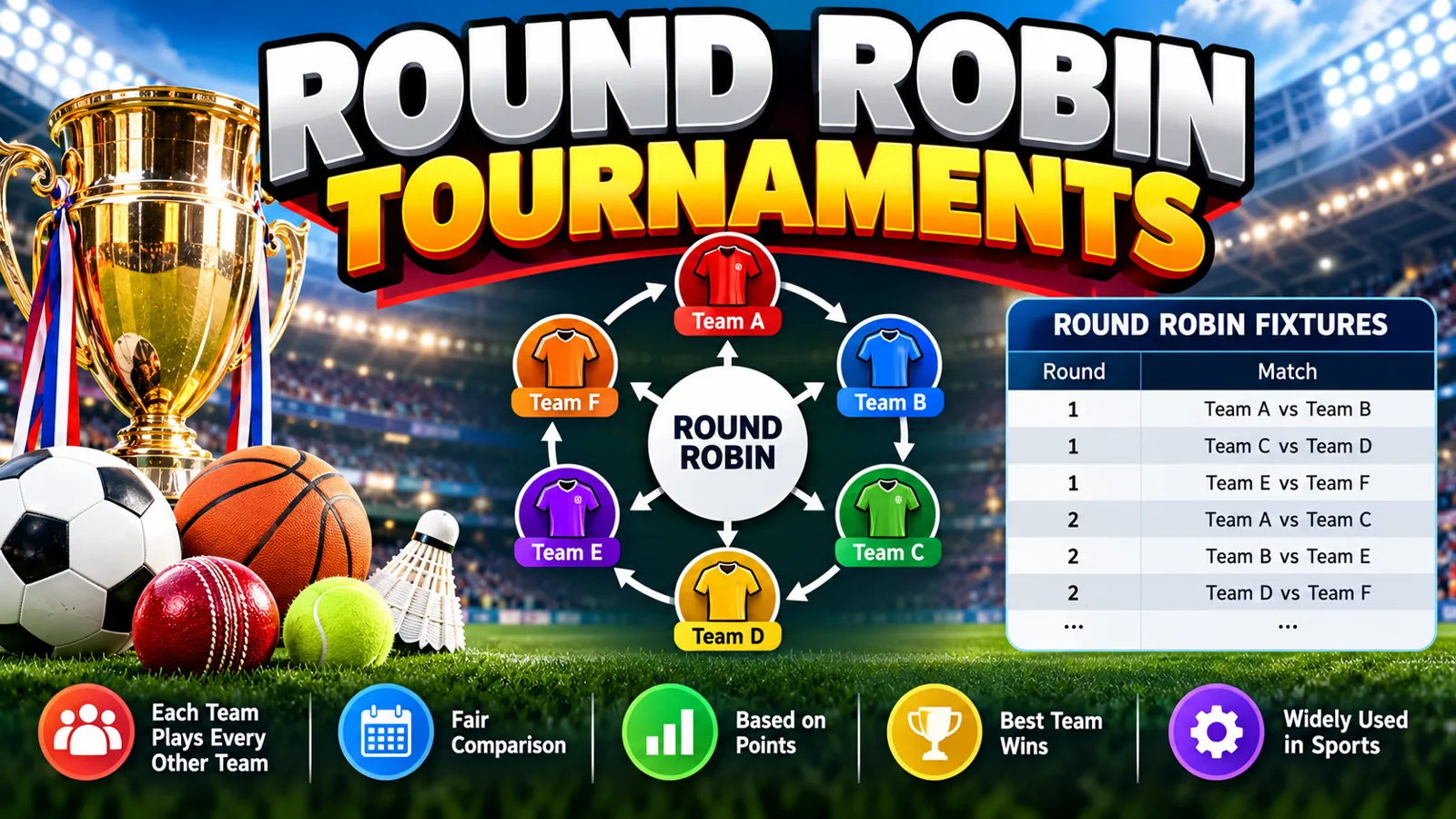
A round robin format lets each participant face every other participant. This planning guide covers fixture counts, bye rounds, fair rotations and trustworthy tables.
Single round robin matches = n × (n − 1) ÷ 2; double round robin matches = n × (n − 1).
Use the matching Sports4u calculator to check the arithmetic; verify competition-specific rules with the organizer.
Choose the format before the schedule
Single round robin gives each pair one meeting; double round robin gives each pair two. Home-and-away competitions often favor double round robin, but a small school competition may lack enough playing time. Decide whether a draw is possible, how points are awarded and whether knockout playoffs follow the league phase. Communicating these decisions before generating fixtures prevents misunderstandings once results begin affecting standings.
Practical check: write down the input values and units first, then verify the operation independently. Interpret the result against the relevant match, workout or competition conditions instead of using the number without context.
Count games before promising a venue
For n teams, single-round-robin matches are n(n−1)/2. Eight teams need 28 games. If you have two fields and can run two games at once, that does not mean the whole tournament will fit into fourteen time slots without checking rests, breaks and venue hours. Calculate the available matches per session, add buffers and account for teams moving between playing areas. A realistic schedule leaves space for overtime or delays.
Practical check: write down the input values and units first, then verify the operation independently. Interpret the result against the relevant match, workout or competition conditions instead of using the number without context.
Odd team counts and byes
When the participant count is odd, one team sits out in each round of the common circle-method schedule. For seven teams, there are seven rounds and each team normally receives one bye. Record byes openly so participants know their periods of rest. A bye is not always equivalent to points or a win; assign it whatever treatment the event rules specify, and never assume that a bye automatically changes the standings.
Practical check: write down the input values and units first, then verify the operation independently. Interpret the result against the relevant match, workout or competition conditions instead of using the number without context.
Use the circle method carefully
The standard rotation method keeps one slot fixed while other slots rotate to produce unique pairings. For an odd number of teams, add a placeholder bye to make the rotation even. This approach reduces accidental duplicate pairings. Still review the output for home/away balance, consecutive games, venue constraints and collisions with staff availability. Algorithmic correctness does not guarantee a practical timetable.
Practical check: write down the input values and units first, then verify the operation independently. Interpret the result against the relevant match, workout or competition conditions instead of using the number without context.
Rest, weather and participant welfare
A youth football tournament may need longer breaks than a casual table-tennis round robin. Consider match duration, warm-up, field turnover, hydration and heat exposure. Include a contingency plan for weather or facility closure and avoid assigning the same participant back-to-back games when alternatives exist. Organizers should follow their sport’s official safeguarding and medical procedures; a fixture generator cannot determine safe exercise levels for individual participants.
Practical check: write down the input values and units first, then verify the operation independently. Interpret the result against the relevant match, workout or competition conditions instead of using the number without context.
Design the scoring and tie-break rules
Publish how to score wins, draws, losses, forfeits and abandoned games. Define the order of tie-break criteria before the first match, whether it is head-to-head, point differential, goal difference, fewest penalties or a playoff. For competitions with unequal games played, specify whether ranking is based on total points or a defined ratio. Do not change tie-break rules after results are known just because the final ranking appears surprising.
Practical check: write down the input values and units first, then verify the operation independently. Interpret the result against the relevant match, workout or competition conditions instead of using the number without context.
Record results in a traceable format
Keep a master fixture list with match ID, round, start time, venue, teams, result and update status. A table should be calculated from confirmed match results rather than manually edited after each game. Preserve corrections and indicate when an outcome is provisional or under review. If a team withdraws, apply the published withdrawal procedure consistently. Transparent records are more useful than a decorative bracket that cannot be audited.
Practical check: write down the input values and units first, then verify the operation independently. Interpret the result against the relevant match, workout or competition conditions instead of using the number without context.
Prepare a participant-facing pack
Before the event, share an accessible schedule, contact method, venue directions, check-in time, equipment list and rules summary. State the method for reporting scores and resolving disputes. Keep a printed fallback if the venue has poor connectivity. During the tournament, update results promptly and announce schedule changes through the same channel. At the end, archive the final fixture list and table so participants can verify the outcome.
Practical check: write down the input values and units first, then verify the operation independently. Interpret the result against the relevant match, workout or competition conditions instead of using the number without context.
Worked examples and situations to practice
These are hypothetical practice figures, not live scores or real athlete records. They are designed to make the calculations auditable and help you recognize common input errors.
Four teams
Result: 6 total single round-robin matches.
Six unique fixtures; three rounds if all teams play in each round.
Try this: Recalculate the result from the raw figures. Decide which additional context, such as competition rules, attempts, wickets or playing conditions, you would need before drawing a conclusion.
Five teams
Result: 10 total single round-robin matches.
Ten fixtures and one bye per round; normally five rounds.
Try this: Recalculate the result from the raw figures. Decide which additional context, such as competition rules, attempts, wickets or playing conditions, you would need before drawing a conclusion.
Six teams
Result: 15 total single round-robin matches.
Fifteen fixtures organized across five rounds.
Try this: Recalculate the result from the raw figures. Decide which additional context, such as competition rules, attempts, wickets or playing conditions, you would need before drawing a conclusion.
Seven teams
Result: 21 total single round-robin matches.
Twenty-one fixtures with one bye in each of seven rounds.
Try this: Recalculate the result from the raw figures. Decide which additional context, such as competition rules, attempts, wickets or playing conditions, you would need before drawing a conclusion.
Eight teams
Result: 28 total single round-robin matches.
Twenty-eight fixtures across seven rounds.
Try this: Recalculate the result from the raw figures. Decide which additional context, such as competition rules, attempts, wickets or playing conditions, you would need before drawing a conclusion.
Nine teams
Result: 36 total single round-robin matches.
Thirty-six fixtures with bye rotations.
Try this: Recalculate the result from the raw figures. Decide which additional context, such as competition rules, attempts, wickets or playing conditions, you would need before drawing a conclusion.
Ten teams
Result: 45 total single round-robin matches.
Forty-five fixtures across nine rounds.
Try this: Recalculate the result from the raw figures. Decide which additional context, such as competition rules, attempts, wickets or playing conditions, you would need before drawing a conclusion.
Twelve teams
Result: 66 total single round-robin matches.
Sixty-six games before any playoffs.
Try this: Recalculate the result from the raw figures. Decide which additional context, such as competition rules, attempts, wickets or playing conditions, you would need before drawing a conclusion.
Key terms and definitions
- Round robin
- A competition in which each participant meets every other participant.
- Bye
- A round when a participant does not play because the field has an odd number.
- Single round robin
- One meeting for each pair of participants.
- Double round robin
- Two meetings for each pair of participants.
Step-by-step accuracy checklist
- Identify the exact question you need answered before selecting a statistic or calculator.
- Write down the original data and its source; do not begin with a rounded display figure.
- Check units, decimal notation, and whether an exception changes the denominator.
- Apply the published formula and retain enough precision for verification.
- Compare the result with an independently worked example or trusted official data.
- Label estimates and provisional calculations clearly; include competition context when applicable.
- Document the date and specific version of any competition rule used.
- Use the result to answer the original question rather than making broad claims the number cannot support.
Tools you can use next
For faster calculations, these browser-based tools can help you check sample numbers and experiment with your own inputs. They do not replace official match records, medical advice or an event organizer’s rulebook.
Frequently asked questions
How many matches do eight teams play?
Twenty-eight in a single round robin, or fifty-six in a double round robin. When comparing results, keep the original measurements available and confirm any rules or assumptions that affect the calculation.
Do odd-sized groups work?
Yes. Use a bye placeholder and rotate it between participants. When comparing results, keep the original measurements available and confirm any rules or assumptions that affect the calculation.
Can a round robin lead to a final?
Yes. An event can advance the highest-ranked participants to a separate knockout stage. When comparing results, keep the original measurements available and confirm any rules or assumptions that affect the calculation.
Does a fixture generator handle venue conflicts?
A basic generator creates pairings; organizers must review real-world constraints. When comparing results, keep the original measurements available and confirm any rules or assumptions that affect the calculation.
Editorial note: This educational guide uses hypothetical worked examples and transparent arithmetic. Sports4u does not claim that calculations represent official competition statistics. Always check the relevant governing body or organizer for event-specific rules.