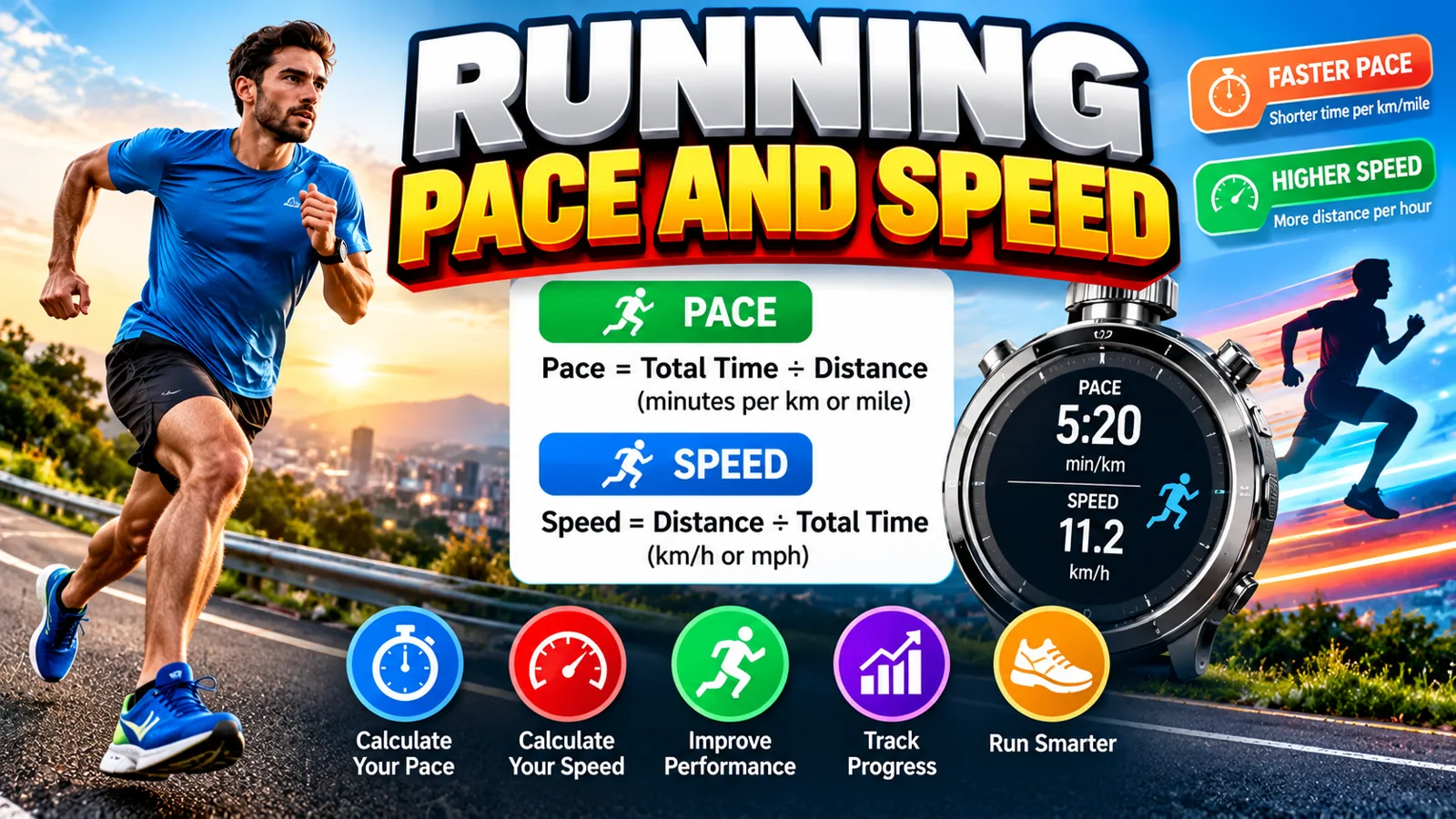
Pace tells you the time to cover a unit of distance while speed tells you the distance covered per unit of time. Learn both calculations with real training examples.
Pace (min/km) = total minutes ÷ distance in km; speed (km/h) = distance in km ÷ time in hours.
Use the matching Sports4u calculator to check the arithmetic; verify competition-specific rules with the organizer.
Read pace as a clock value
A pace of 5:30 min/km is five minutes and thirty seconds per kilometer, not 5.30 decimal minutes. To calculate with numbers, convert 5:30 to 5.5 minutes. Conversely, 5.75 minutes is five minutes and forty-five seconds, not five minutes seventy-five seconds. This common confusion creates errors in training schedules and race predictions. Keep pace in minutes and seconds when displaying it to runners.
Practical check: write down the input values and units first, then verify the operation independently. Interpret the result against the relevant match, workout or competition conditions instead of using the number without context.
Use consistent measurement units
If your distance is in kilometers, convert running time to minutes to calculate min/km. To calculate speed, convert time to hours. A five-kilometer run completed in twenty-five minutes has a pace of 25/5 = five minutes per kilometer and a speed of 5/(25/60) = twelve kilometers per hour. If distance is in miles, calculate min/mile and make the label obvious. Avoid comparing the number on a min/mile watch with a min/km training plan.
Practical check: write down the input values and units first, then verify the operation independently. Interpret the result against the relevant match, workout or competition conditions instead of using the number without context.
Elapsed versus moving pace
Sports watches may report pace using moving time while a race result uses elapsed timing or chip timing, depending on the event. A runner covering five kilometers in thirty minutes including two minutes stopped would have a 6:00 elapsed pace but about 5:36 moving pace. Neither figure is inherently dishonest; they answer different questions. Always indicate which time basis you used, especially when comparing an outdoor session with an officially timed race.
Practical check: write down the input values and units first, then verify the operation independently. Interpret the result against the relevant match, workout or competition conditions instead of using the number without context.
Why GPS pace fluctuates
A watch estimates distance from sensor readings. Tall buildings, trees, tight corners, tunnels and poor GPS reception can produce temporary variations. Instantaneous pace may jump even when effort remains steady. For a training session, average lap pace or measured-track splits are often easier to interpret. Don’t make abrupt effort changes in response to every momentary reading. Confirm distance on a measured course when precision is especially important.
Practical check: write down the input values and units first, then verify the operation independently. Interpret the result against the relevant match, workout or competition conditions instead of using the number without context.
Choose pace according to purpose
An easy run, recovery jog, threshold session, short interval and race effort serve different purposes. A single target pace is not appropriate for every workout. Weather, hills, fatigue and surface conditions change the effort required to maintain a particular split. Use pace alongside perceived exertion and a training plan rather than treating the fastest achievable number as the correct goal. Increase workload gradually and adapt plans to your individual circumstances.
Practical check: write down the input values and units first, then verify the operation independently. Interpret the result against the relevant match, workout or competition conditions instead of using the number without context.
How to use split times
A split is the time spent covering a defined section, often one kilometer or mile. Record successive splits to see whether a run was even, progressive or fading. For example, five splits of 6:00, 5:55, 5:50, 5:45 and 5:40 show a gradual increase in speed. On a hilly course, different split times may reflect terrain rather than effort. Interpret performance together with elevation and conditions.
Practical check: write down the input values and units first, then verify the operation independently. Interpret the result against the relevant match, workout or competition conditions instead of using the number without context.
Converting min/km and km/h
The conversion formula is speed in km/h = 60 divided by pace in decimal minutes per kilometer. Thus 6:00 min/km corresponds to 10 km/h and 4:00 min/km corresponds to 15 km/h. To reverse the conversion, divide sixty by km/h. A treadmill displaying 12 km/h corresponds to a five-minute kilometer pace. The faster you run, the smaller the numeric minutes-per-kilometer value becomes.
Practical check: write down the input values and units first, then verify the operation independently. Interpret the result against the relevant match, workout or competition conditions instead of using the number without context.
Race predictions are estimates
A pace calculator can project finish time by multiplying the target distance by an assumed pace. A race predictor may apply a model that changes pace over longer distances. Both are estimates, not guarantees. Race course, training, heat, hydration, hills and fatigue alter performance. Particularly for longer events, use predictions as planning tools and be prepared to adjust pacing during the race. Do not confuse a mathematical forecast with an assessment of medical readiness.
Practical check: write down the input values and units first, then verify the operation independently. Interpret the result against the relevant match, workout or competition conditions instead of using the number without context.
Worked examples and situations to practice
These are hypothetical practice figures, not live scores or real athlete records. They are designed to make the calculations auditable and help you recognize common input errors.
Easy 5K
Result: 6:00 min/km.
Five kilometers in thirty minutes is 6:00 min/km and 10.0 km/h.
Try this: Recalculate the result from the raw figures. Decide which additional context, such as competition rules, attempts, wickets or playing conditions, you would need before drawing a conclusion.
Tempo 5K
Result: 5:00 min/km.
Five kilometers in twenty-five minutes is 5:00 min/km and 12.0 km/h.
Try this: Recalculate the result from the raw figures. Decide which additional context, such as competition rules, attempts, wickets or playing conditions, you would need before drawing a conclusion.
Short run
Result: 6:00 min/km.
Three kilometers in eighteen minutes is 6:00 min/km.
Try this: Recalculate the result from the raw figures. Decide which additional context, such as competition rules, attempts, wickets or playing conditions, you would need before drawing a conclusion.
Steady 10K
Result: 5:30 min/km.
Ten kilometers in fifty-five minutes is 5:30 min/km.
Try this: Recalculate the result from the raw figures. Decide which additional context, such as competition rules, attempts, wickets or playing conditions, you would need before drawing a conclusion.
Longer outing
Result: 6:00 min/km.
Twelve kilometers in seventy-two minutes is 6:00 min/km.
Try this: Recalculate the result from the raw figures. Decide which additional context, such as competition rules, attempts, wickets or playing conditions, you would need before drawing a conclusion.
Fast kilometer
Result: 4:15 min/km.
One kilometer in four minutes fifteen seconds is 4:15 min/km.
Try this: Recalculate the result from the raw figures. Decide which additional context, such as competition rules, attempts, wickets or playing conditions, you would need before drawing a conclusion.
Park jog
Result: 7:00 min/km.
Four kilometers in twenty-eight minutes is 7:00 min/km.
Try this: Recalculate the result from the raw figures. Decide which additional context, such as competition rules, attempts, wickets or playing conditions, you would need before drawing a conclusion.
Half hour workout
Result: 5:00 min/km.
Six kilometers in thirty minutes is 5:00 min/km.
Try this: Recalculate the result from the raw figures. Decide which additional context, such as competition rules, attempts, wickets or playing conditions, you would need before drawing a conclusion.
Key terms and definitions
- Pace
- Elapsed time for each kilometer or mile.
- Speed
- Distance covered per unit of time.
- Elapsed time
- Total clock time including stops unless the recording method excludes them.
- Moving time
- Time in motion; it can differ from elapsed time.
Step-by-step accuracy checklist
- Identify the exact question you need answered before selecting a statistic or calculator.
- Write down the original data and its source; do not begin with a rounded display figure.
- Check units, decimal notation, and whether an exception changes the denominator.
- Apply the published formula and retain enough precision for verification.
- Compare the result with an independently worked example or trusted official data.
- Label estimates and provisional calculations clearly; include competition context when applicable.
- Document the date and specific version of any competition rule used.
- Use the result to answer the original question rather than making broad claims the number cannot support.
Tools you can use next
For faster calculations, these browser-based tools can help you check sample numbers and experiment with your own inputs. They do not replace official match records, medical advice or an event organizer’s rulebook.
Frequently asked questions
Is a lower pace faster?
Yes. A lower minutes-per-kilometer figure means less time needed per kilometer. When comparing results, keep the original measurements available and confirm any rules or assumptions that affect the calculation.
Is a higher speed faster?
Yes. Greater km/h means more distance covered in an hour. When comparing results, keep the original measurements available and confirm any rules or assumptions that affect the calculation.
How do I convert 5:30 to decimal minutes?
Calculate 5 + 30/60 = 5.5 minutes. When comparing results, keep the original measurements available and confirm any rules or assumptions that affect the calculation.
Why does my watch differ from a race clock?
GPS distance estimates and the use of moving versus elapsed time can both cause differences. When comparing results, keep the original measurements available and confirm any rules or assumptions that affect the calculation.
Editorial note: This educational guide uses hypothetical worked examples and transparent arithmetic. Sports4u does not claim that calculations represent official competition statistics. Always check the relevant governing body or organizer for event-specific rules.