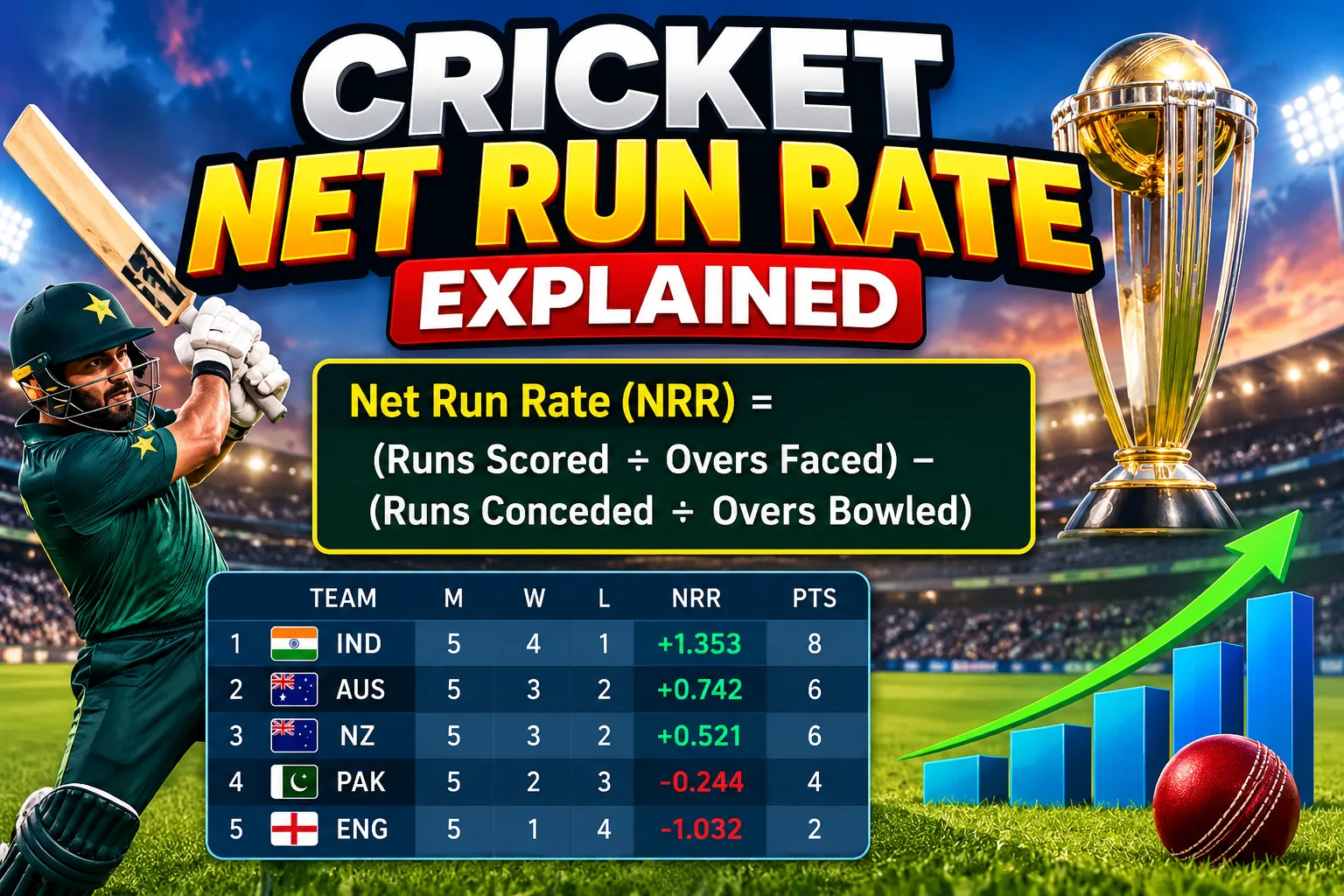
Net run rate compares a team’s aggregate scoring pace with the aggregate pace conceded across matches. It is a tournament tie-break metric, not simply an average of match margins.
Simplified NRR = (total runs scored ÷ overs faced) − (total runs conceded ÷ overs bowled).
Use the matching Sports4u calculator to check the arithmetic; verify competition-specific rules with the organizer.
What net run rate actually measures
NRR subtracts the scoring speed allowed to opponents from the scoring speed achieved by a team. A positive number means the team scored faster overall than opponents scored against it, under the competition’s stipulated calculation rules. A negative number indicates the reverse. Unlike points, which identify wins, draws or results, NRR often helps rank teams with equal points. It should not replace the official points table or be interpreted as a measure of individual player ability.
Practical check: write down the input values and units first, then verify the operation independently. Interpret the result against the relevant match, workout or competition conditions instead of using the number without context.
Why match-by-match averaging is wrong
Suppose one match lasted five overs and another lasted twenty overs. Giving the two match rates equal weight produces an inaccurate tournament figure because the lengths differ. Instead, add the runs scored across qualifying games and divide by the aggregate overs faced. Repeat for runs conceded and overs bowled. Subtract the latter rate from the former. This weighted approach is central to understanding why a late result changes the table by an amount that may be surprising.
Practical check: write down the input values and units first, then verify the operation independently. Interpret the result against the relevant match, workout or competition conditions instead of using the number without context.
The all-out innings complication
Many limited-overs competitions treat a team dismissed before the scheduled allocation as having used the full applicable overs for NRR purposes. That means an all-out side scoring 100 in 15 overs of a 20-over match may be assigned 20 overs for this calculation, despite its live run rate being 6.67 at dismissal. It is essential to consult the exact tournament playing conditions rather than mechanically copying a ball-by-ball score. This site’s general calculator is educational and cannot automatically model every competition exception.
Practical check: write down the input values and units first, then verify the operation independently. Interpret the result against the relevant match, workout or competition conditions instead of using the number without context.
Rain and revised targets
Reduced-overs matches, abandoned matches and revised targets can change the innings totals and overs applied to NRR. Some competitions use adjusted figures associated with the revised target; others prescribe their own details. Never copy a regular twenty-over calculation onto a shortened rain-affected game without checking the tournament rules. If official statistics disagree with your spreadsheet, read the playing conditions first. A web calculator that lacks the particular exception cannot be treated as the authoritative table.
Practical check: write down the input values and units first, then verify the operation independently. Interpret the result against the relevant match, workout or competition conditions instead of using the number without context.
How an upset changes a table
A narrow win can earn the same competition points as a large win but contribute a very different NRR. An emphatic chase with overs to spare often increases the winning side’s scoring rate, while a heavy defeat can lower the losing side’s overall figure. That does not mean every late boundary has an identical effect. Its impact depends on the existing tournament aggregates and the number of runs and balls still to be included.
Practical check: write down the input values and units first, then verify the operation independently. Interpret the result against the relevant match, workout or competition conditions instead of using the number without context.
Understanding overs input
Always convert ball-based notation to actual overs. A score of 137 in 18.3 means 111 legal balls, or 18.5 decimal overs. Use the same principle for the overs bowled against opponents. Treating 18.3 as a decimal number produces a wrong rate. Where an all-out adjustment applies, first identify the competition’s prescribed denominator, then convert that denominator accurately. Record whether a row uses observed deliveries or adjusted innings allocations.
Practical check: write down the input values and units first, then verify the operation independently. Interpret the result against the relevant match, workout or competition conditions instead of using the number without context.
Publishing a responsible NRR table
Show matches played, points and NRR alongside one another. Add a note describing the competition format, all-out treatment and any rain-related exceptions. Display at least two decimal places where useful, but keep higher precision for sorting if the governing rules require it. A transparent table allows readers to understand differences in rankings. Never claim an independently calculated table is official without confirming it against the organizer’s published figures.
Practical check: write down the input values and units first, then verify the operation independently. Interpret the result against the relevant match, workout or competition conditions instead of using the number without context.
How to audit a discrepancy
Start by identifying the exact match that caused a difference. Compare runs for and against, then legal deliveries for and against. Check early dismissals, successful chases, forfeits, no-results and revised-over matches. Recalculate the aggregates after each fixture instead of averaging individually calculated match NRR. Finally, verify the tie-break ordering: some leagues use number of wins or head-to-head outcomes before NRR. If all inputs are correct yet the discrepancy remains, the competition rules may use a special adjustment.
Practical check: write down the input values and units first, then verify the operation independently. Interpret the result against the relevant match, workout or competition conditions instead of using the number without context.
Worked examples and situations to practice
These are hypothetical practice figures, not live scores or real athlete records. They are designed to make the calculations auditable and help you recognize common input errors.
Even rates
Result: 7.50 runs per over (one component of NRR).
If 300 runs are scored in 40 overs, the batting rate is 7.50.
Try this: Recalculate the result from the raw figures. Decide which additional context, such as competition rules, attempts, wickets or playing conditions, you would need before drawing a conclusion.
Fast scoring
Result: 10.00 runs per over (one component of NRR).
If 200 runs take 20 overs, the batting rate is 10.00.
Try this: Recalculate the result from the raw figures. Decide which additional context, such as competition rules, attempts, wickets or playing conditions, you would need before drawing a conclusion.
Slow innings
Result: 6.00 runs per over (one component of NRR).
If 120 runs take 20 overs, the batting rate is 6.00.
Try this: Recalculate the result from the raw figures. Decide which additional context, such as competition rules, attempts, wickets or playing conditions, you would need before drawing a conclusion.
Short innings
Result: 8.00 runs per over (one component of NRR).
If 80 runs take 10 overs, the batting rate is 8.00.
Try this: Recalculate the result from the raw figures. Decide which additional context, such as competition rules, attempts, wickets or playing conditions, you would need before drawing a conclusion.
An ODI spell
Result: 5.00 runs per over (one component of NRR).
250 runs in 50 overs gives a rate of 5.00.
Try this: Recalculate the result from the raw figures. Decide which additional context, such as competition rules, attempts, wickets or playing conditions, you would need before drawing a conclusion.
Balanced aggregate
Result: 7.00 runs per over (one component of NRR).
420 scored across 60 overs is 7.00 per over.
Try this: Recalculate the result from the raw figures. Decide which additional context, such as competition rules, attempts, wickets or playing conditions, you would need before drawing a conclusion.
Dominant batting
Result: 8.25 runs per over (one component of NRR).
495 scored across 60 overs is 8.25 per over.
Try this: Recalculate the result from the raw figures. Decide which additional context, such as competition rules, attempts, wickets or playing conditions, you would need before drawing a conclusion.
Defensive tournament
Result: 6.00 runs per over (one component of NRR).
360 runs in 60 overs means 6.00 per over.
Try this: Recalculate the result from the raw figures. Decide which additional context, such as competition rules, attempts, wickets or playing conditions, you would need before drawing a conclusion.
Key terms and definitions
- For rate
- Total runs scored divided by total overs used across the relevant matches.
- Against rate
- Total runs conceded divided by total overs bowled across those matches.
- Aggregate
- Combine runs and playing time before dividing, rather than averaging match NRR values.
- All-out adjustment
- Official limited-overs rules can count the full scheduled allocation when a team is dismissed early.
Step-by-step accuracy checklist
- Identify the exact question you need answered before selecting a statistic or calculator.
- Write down the original data and its source; do not begin with a rounded display figure.
- Check units, decimal notation, and whether an exception changes the denominator.
- Apply the published formula and retain enough precision for verification.
- Compare the result with an independently worked example or trusted official data.
- Label estimates and provisional calculations clearly; include competition context when applicable.
- Document the date and specific version of any competition rule used.
- Use the result to answer the original question rather than making broad claims the number cannot support.
Tools you can use next
For faster calculations, these browser-based tools can help you check sample numbers and experiment with your own inputs. They do not replace official match records, medical advice or an event organizer’s rulebook.
Frequently asked questions
Can a losing side have positive NRR?
Yes, across multiple matches it is possible to lose a match yet retain a positive aggregate NRR. When comparing results, keep the original measurements available and confirm any rules or assumptions that affect the calculation.
Should I average individual match NRR values?
No. Aggregate all applicable runs and overs before calculating the rates. When comparing results, keep the original measurements available and confirm any rules or assumptions that affect the calculation.
Does an all-out innings always use its actual overs?
Not in many limited-overs tournament NRR methods; check the competition rules. When comparing results, keep the original measurements available and confirm any rules or assumptions that affect the calculation.
Is this calculator the official tournament table?
No. Official standings and exceptions come from the competition organizer. When comparing results, keep the original measurements available and confirm any rules or assumptions that affect the calculation.
Editorial note: This educational guide uses hypothetical worked examples and transparent arithmetic. Sports4u does not claim that calculations represent official competition statistics. Always check the relevant governing body or organizer for event-specific rules.