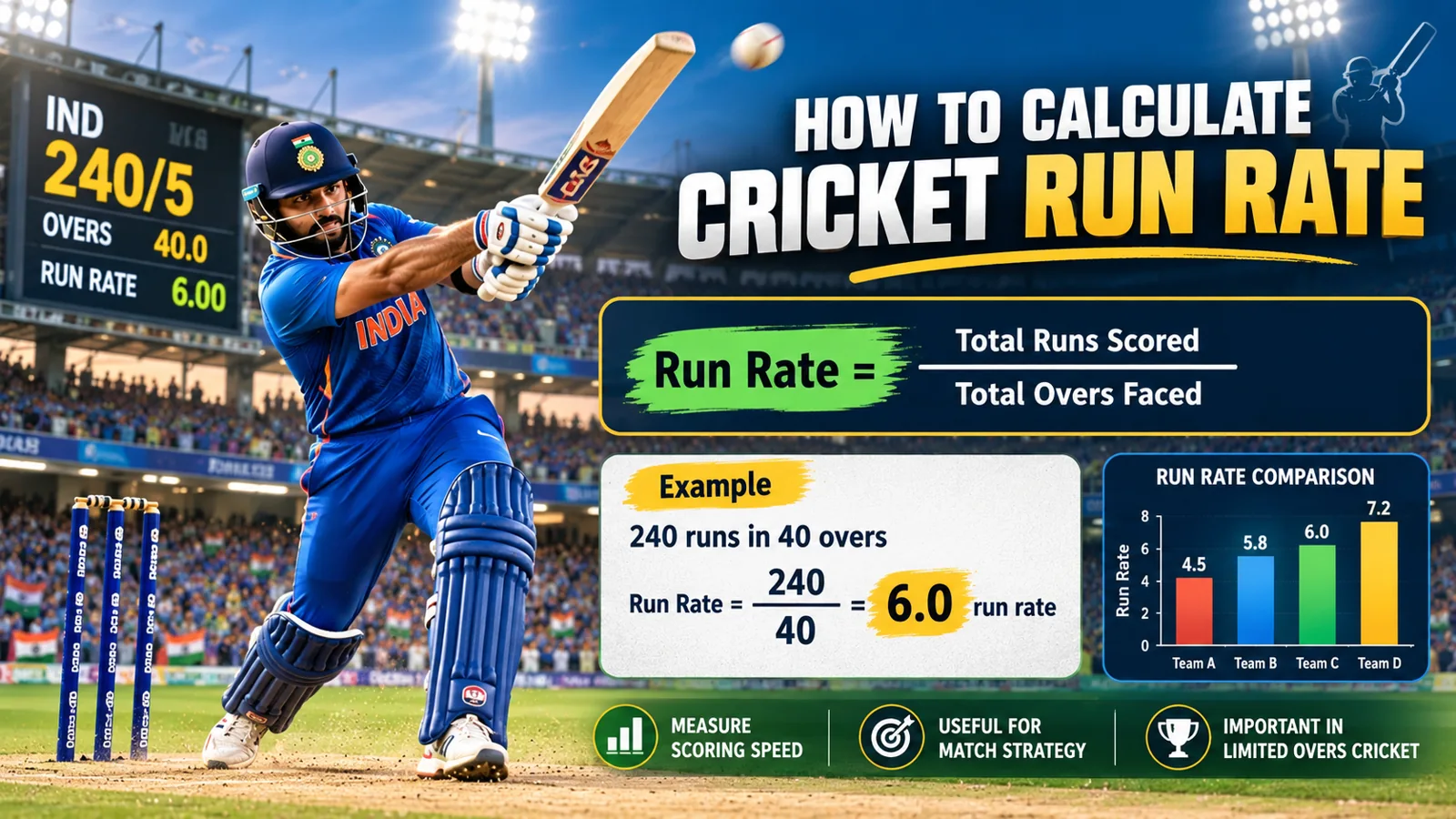
A run rate describes scoring speed in runs per six legal balls. This guide explains how to calculate it by hand, interpret scorecards and avoid the decimal-over trap.
Current run rate = total runs scored ÷ (legal deliveries faced ÷ 6).
Use the matching Sports4u calculator to check the arithmetic; verify competition-specific rules with the organizer.
Why the unit matters
Run rate is a rate, rather than a prediction. It describes scoring relative to the number of legal deliveries actually faced. Two sides can both have 90 runs, yet the side reaching that score in ten overs has scored faster than one taking twelve overs. The metric is useful for comparing passages of play, judging whether a chase is on schedule and discussing momentum. It cannot by itself describe wickets remaining, conditions or the quality of the bowling.
Practical check: write down the input values and units first, then verify the operation independently. Interpret the result against the relevant match, workout or competition conditions instead of using the number without context.
Convert scoreboard overs correctly
On a cricket scoreboard, 18.2 means 18 complete overs and two legal balls, not 18.2 decimal overs. Multiply complete overs by six and add the balls: 18 × 6 + 2 = 110 legal deliveries. The proper denominator is then 110 ÷ 6 = 18.3333 decimal overs. Always convert the notation before dividing runs by overs. After five legal deliveries the next legal ball completes the over; a notation such as 12.6 is normally written as 13.0.
Practical check: write down the input values and units first, then verify the operation independently. Interpret the result against the relevant match, workout or competition conditions instead of using the number without context.
What to do with extras
Wides and no-balls can add runs without consuming a legal delivery, although match-specific playing conditions may affect further consequences. These runs belong in the total score, but the invalid ball itself is not counted toward the six legal deliveries. By contrast, a bye or leg bye can be scored from a legal delivery. If a scorecard lists 14.4 overs after a wide, check that the recorded ball count has not changed; adding one to the ball count would understate the scoring rate.
Practical check: write down the input values and units first, then verify the operation independently. Interpret the result against the relevant match, workout or competition conditions instead of using the number without context.
Current rate compared with target rate
Current run rate uses runs already scored divided by overs already faced. Required run rate begins with runs still needed to win and remaining legal deliveries. A team on 80 after 10 overs of a T20 chase has a current rate of eight. If the target is 181, it still needs 101 runs in 60 balls, a required rate of 10.10. The gap tells you more than either number alone. Wickets, boundary opportunities and bowling matchups still shape whether the target is realistic.
Practical check: write down the input values and units first, then verify the operation independently. Interpret the result against the relevant match, workout or competition conditions instead of using the number without context.
Using the rate in different match formats
The arithmetic stays the same in T20, one-day and longer formats, but the interpretation changes. A run rate above nine may be routine in a brief T20 surge yet aggressive across a long one-day innings. In a Test match, a team may deliberately score slowly to preserve wickets and manage time. Avoid treating one universal run rate as good or bad. Always mention the format, stage of innings and available overs when comparing performances.
Practical check: write down the input values and units first, then verify the operation independently. Interpret the result against the relevant match, workout or competition conditions instead of using the number without context.
Rounding without misleading readers
Calculate using the precise delivery count, then round the displayed answer to two decimal places. If the score is 147 after 18 overs and two balls, divide 147 by 110/6, not by 18.2. Rounding the denominator too early can change the answer. When documenting analysis, retain the underlying runs and deliveries as well as the rounded rate. That makes a result independently reproducible and lets someone correct a scorecard entry without guessing which calculation you used.
Practical check: write down the input values and units first, then verify the operation independently. Interpret the result against the relevant match, workout or competition conditions instead of using the number without context.
How to check a scorecard
First verify the total runs, then the precise number of legal balls. Second, look for innings ending early through an all-out situation or a successful chase. Third, identify whether the displayed rate is current, required or tournament net run rate; the three measures answer different questions. Finally, recreate the calculation with a calculator or spreadsheet. If you get a different answer, the most common explanation is mixing scoreboard notation with decimal overs.
Practical check: write down the input values and units first, then verify the operation independently. Interpret the result against the relevant match, workout or competition conditions instead of using the number without context.
How to use this guide in practice
For coaching, ask batters to record runs and legal deliveries in blocks of six or twelve balls. Discuss changes in tempo rather than praising the largest number automatically. For fantasy or fan analysis, compare periods at similar stages and note boundaries, dot balls and wickets. For a chase, calculate the required rate after each complete over and use it alongside available batting resources. Rates are summaries of events, not instructions to take reckless risks.
Practical check: write down the input values and units first, then verify the operation independently. Interpret the result against the relevant match, workout or competition conditions instead of using the number without context.
Worked examples and situations to practice
These are hypothetical practice figures, not live scores or real athlete records. They are designed to make the calculations auditable and help you recognize common input errors.
Powerplay
Result: 9.17 runs per over.
Six complete overs; use 55 ÷ 6 = 9.17 runs per over.
Try this: Recalculate the result from the raw figures. Decide which additional context, such as competition rules, attempts, wickets or playing conditions, you would need before drawing a conclusion.
Middle overs
Result: 7.92 runs per over.
Thirteen complete overs; use 103 ÷ 13 = 7.92.
Try this: Recalculate the result from the raw figures. Decide which additional context, such as competition rules, attempts, wickets or playing conditions, you would need before drawing a conclusion.
A partial over
Result: 8.02 runs per over.
Eighteen overs and two deliveries are 110 balls, giving 8.02.
Try this: Recalculate the result from the raw figures. Decide which additional context, such as competition rules, attempts, wickets or playing conditions, you would need before drawing a conclusion.
Early innings
Result: 8.77 runs per over.
Two overs and one ball are 13 legal deliveries, giving 8.77.
Try this: Recalculate the result from the raw figures. Decide which additional context, such as competition rules, attempts, wickets or playing conditions, you would need before drawing a conclusion.
End of T20 innings
Result: 8.40 runs per over.
Twenty overs produce a run rate of 8.40.
Try this: Recalculate the result from the raw figures. Decide which additional context, such as competition rules, attempts, wickets or playing conditions, you would need before drawing a conclusion.
A shorter spell
Result: 10.00 runs per over.
Four overs and three deliveries make 27 balls, giving 10.00.
Try this: Recalculate the result from the raw figures. Decide which additional context, such as competition rules, attempts, wickets or playing conditions, you would need before drawing a conclusion.
Chase in progress
Result: 8.73 runs per over.
Eleven overs at 96 runs give 8.73, but this is not the required rate.
Try this: Recalculate the result from the raw figures. Decide which additional context, such as competition rules, attempts, wickets or playing conditions, you would need before drawing a conclusion.
Unusual scoreboard
Result: 9.06 runs per over.
Seven overs and five balls means 47 legal balls; the run rate is 9.06.
Try this: Recalculate the result from the raw figures. Decide which additional context, such as competition rules, attempts, wickets or playing conditions, you would need before drawing a conclusion.
Key terms and definitions
- Legal delivery
- A ball that counts toward the over; wides and no-balls normally do not count as legal balls.
- Over notation
- The digit after the dot is completed legal balls, not a decimal fraction.
- Current run rate
- Average runs scored per completed six-ball over.
- Required run rate
- Average runs per remaining over needed to complete a chase.
Step-by-step accuracy checklist
- Identify the exact question you need answered before selecting a statistic or calculator.
- Write down the original data and its source; do not begin with a rounded display figure.
- Check units, decimal notation, and whether an exception changes the denominator.
- Apply the published formula and retain enough precision for verification.
- Compare the result with an independently worked example or trusted official data.
- Label estimates and provisional calculations clearly; include competition context when applicable.
- Document the date and specific version of any competition rule used.
- Use the result to answer the original question rather than making broad claims the number cannot support.
Tools you can use next
For faster calculations, these browser-based tools can help you check sample numbers and experiment with your own inputs. They do not replace official match records, medical advice or an event organizer’s rulebook.
Frequently asked questions
Is 18.2 the same as 18.2 decimal overs?
No. It represents 18 complete six-ball overs plus two legal balls; the decimal denominator is 18 + 2/6. When comparing results, keep the original measurements available and confirm any rules or assumptions that affect the calculation.
Can the rate go down after scoring runs?
Yes. If scoring during the next deliveries is slower than the existing average, the overall rate falls. When comparing results, keep the original measurements available and confirm any rules or assumptions that affect the calculation.
Does a wide count toward balls faced?
It usually adds runs but not a legal ball; verify the match rules and scorecard. When comparing results, keep the original measurements available and confirm any rules or assumptions that affect the calculation.
Is run rate the same as NRR?
No. A match or innings run rate is not the same as a tournament-wide net run rate. When comparing results, keep the original measurements available and confirm any rules or assumptions that affect the calculation.
Editorial note: This educational guide uses hypothetical worked examples and transparent arithmetic. Sports4u does not claim that calculations represent official competition statistics. Always check the relevant governing body or organizer for event-specific rules.